The 10-Second Breakthrough in Stroke Surgery
A breakthrough of this magnitude comes once in a generation. EndoUVTech's globally patented UV surgical system does what no device or drug has done before - dissolving the downstream clots that current stroke care leaves behind, and restoring blood flow where nothing else can reach.
▶ Watch: Introducing the new standard in stroke surgery
Stroke is the #1 cause of disability worldwide - we have the solution to redefine stroke outcomes.
Mechanical stent retrievers and aspiration devices can pull out the main clot, but they cannot dilate constricted arteries or dissolve the downstream platelet clots that cause permanent disability. Drugs like tPA are limited by time and blood flow - and are ineffective on those distal clots. The result: even after a "successful" procedure, most patients never fully recover.
people that you know will have a stroke in their lifetime
strokes globally every year
of patients are left with permanent disability
annual global stroke economic burden
Permanent disabilities are the direct consequence of clots that current technology simply cannot reach:
Vision loss
Paralysis
Speech disorders
Memory loss
Our UV laser system restores blood flow - the #1 unmet need in stroke surgery
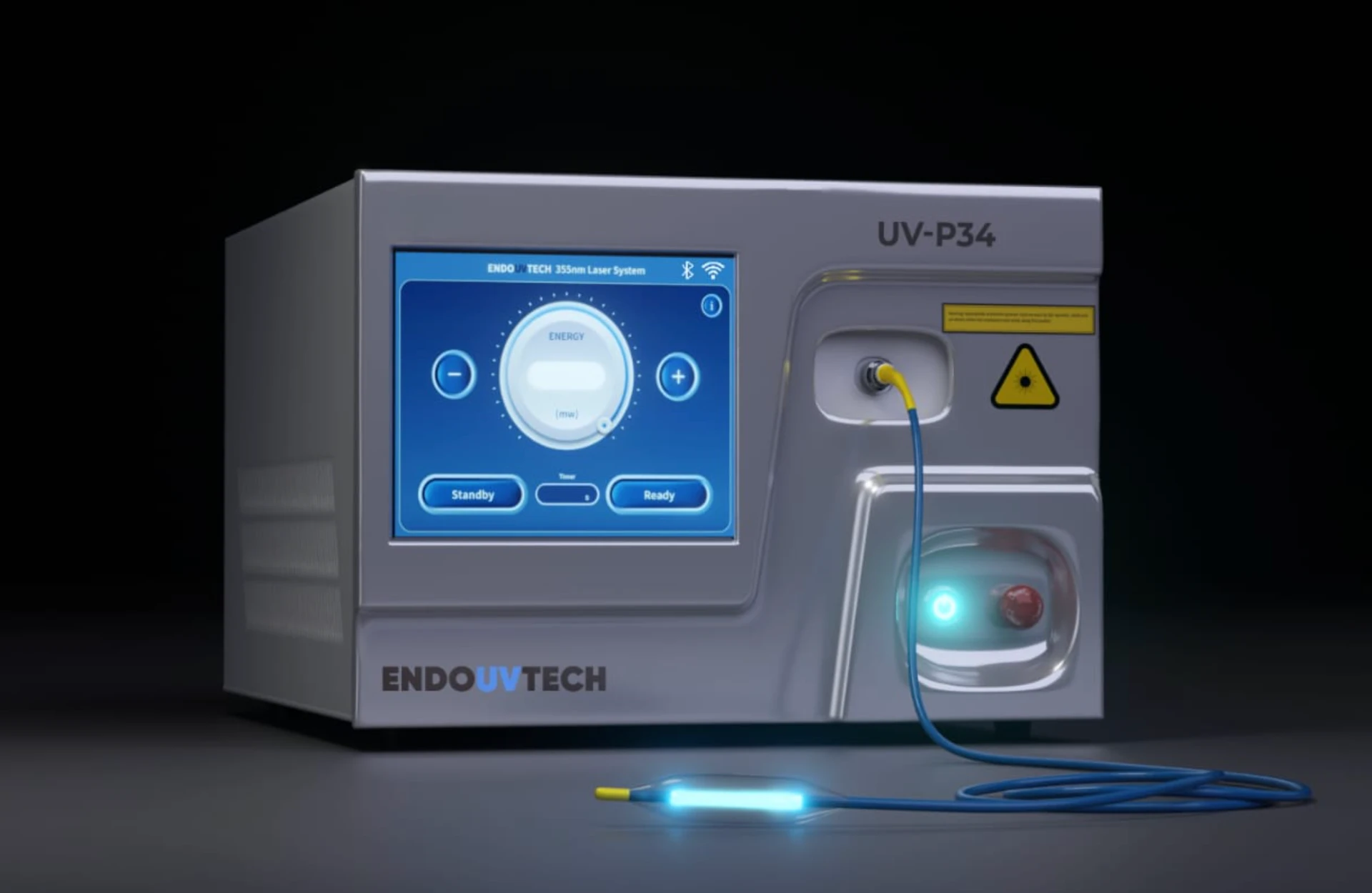
Meet the UV-P34 Laser System
With just seconds of targeted 355nm UV exposure, EndoUVTech safely dilates arterial zones, makes clot removal easier, and dissolves the smaller, previously inaccessible clots that cause lasting damage. It enhances the procedures surgeons already perform - it doesn't replace or compete with them.
A compact bedside console the surgeon runs from a simple touchscreen - set the energy, arm the system from Standby to Ready, and deliver a precise, timed pulse of 355nm UV light.
- The console generates and meters the 355nm UV energy, with Bluetooth / Wi-Fi connectivity, Standby/Ready safety states, and a procedure timer.
- The single-use fiber-optic catheter (the glowing blue tip) threads to the clot site and emits a UV ring beam that dilates the artery and dissolves downstream clots.
- Plug-and-play: it drops into the workflow surgeons already use - working alongside stent retrievers and aspiration catheters, not replacing them.
Vasodilation
Our UV system and single-use fiber-optic balloon catheter safely dilate the artery - laser-facilitated, without damaging the arterial wall.
Recanalization
The main blood clot is now easily removed by current stent retrievers and aspiration devices, with the path opened.
Reperfusion
UV light then dissolves previously inaccessible downstream clots - without tPA - driving rapid, optimal tissue reperfusion.
The science
EndoUVTech's 355nm UV light initiates a proprietary dual mechanism - Photolytic Thrombolysis combined with Laser-Induced Vasodilation - that drives clot dissolution distally, opens microvasculature, and achieves rapid recanalization and reperfusion in regions no existing device or drug can reach. The goal: maximize salvaged tissue and minimize long-term disability.
is all it takes
Arteries only need seconds of UV light to be cleared
This is not minutes of continuous treatment - it is a precisely timed pulse of 355nm UV light delivered at the clot site. In just seconds, the artery dilates and the downstream clots dissolve, restoring blood flow - a fraction of the time of drug thrombolysis and gentler than mechanical retrieval. That brevity is what makes it safe for the brain: minimal energy exposure, no thermal damage to the arterial wall, and no tPA on the clock.
Behind every stroke: a patient, a family, and a lifetime of cost - all of it avoidable
Stroke doesn't end in the operating room. For most survivors it begins a long road of rehabilitation - and a heavy toll on families and the healthcare system. EndoUVTech's technology is the solution to reducing post-stroke disability.
strokes in the U.S. every year - one every 40 seconds
rise in stroke among adults 18-44 (2011-2022) - not only an older person's disease
Why this matters to investors
Disability is where the cost of stroke lives. Every survivor who walks, speaks and lives independently again is a family and a healthcare system spared years of expense - and that is exactly what EndoUVTech's UV system is built to deliver, by dissolving the downstream clots that drive permanent disability. It targets the most expensive, life-altering outcome in stroke care, which makes better recovery not just a clinical win but the core of the value proposition.
The patient
60% of survivors are left with permanent disability. Paralysis, speech loss, vision loss, and memory loss can end independence - and mean months to years of rehabilitation.
The family
Families become full-time caregivers. Informal care and lost income cost households thousands of dollars a year per survivor, on top of the emotional and physical strain.
The cost
U.S. stroke care can reach ~$59,900 per patient per year and up to $500,000 in lifetime post-stroke care - a major driver of the $890B+ global stroke burden.
Sources: American Heart Association, Heart Disease & Stroke Statistics - 2025 Update; CDC Stroke Facts (2024); U.S. stroke cost-of-illness reviews. Figures are population statistics, not EndoUVTech projections.
American Heart Association®
Learn more about stroke
Stroke is a leading cause of death and the leading cause of long-term disability in the U.S. - and it can happen to anyone, at any age, at any time. Most strokes are ischemic, caused by a clot blocking blood flow to the brain - the exact mechanism EndoUVTech's UV system is designed to address. Know the warning signs - B.E. F.A.S.T.: Balance loss, Eye/vision changes, Face drooping, Arm weakness, Speech difficulty, Time to call 911.
Stroke Facts - American Stroke Association →Stroke facts adapted from the American Stroke Association (stroke.org). This reference is provided for educational purposes only and is not an endorsement by the American Stroke Association or the American Heart Association of EndoUVTech or this offering. "American Stroke Association" and "American Heart Association" are trademarks of the American Heart Association, Inc.
A globally patented moat - protected into the 2040s
EndoUVTech holds 8 U.S. patents (granted or allowed) and 3 international applications covering the UV laser dilation technology, the specialized optical fiber and balloon catheter, and the methods behind them. The core mechanism - UV light that triggers nitric-oxide (NO·) release to gently relax and dilate the artery in all directions - is protected through 2041, with newer filings extending to 2045.
U.S. patents granted or allowed
international applications filed
protection through 2041 (newer filings to 2045)
nitric-oxide dilation - the patented mechanism
| Patent | Title | Status |
|---|---|---|
| US 12,133,681 | UV Laser Technology for Gentle Artery Dilation | Granted · Nov 2024 |
| US 11,963,720 | Specialized Optical Fiber for UV Laser Arterial Dilation | Granted · Apr 2024 |
| US 11,446,089 | Conical-Tip UV Laser System for Safer Clot Removal | Granted · Sep 2022 |
| US 12,440,270 | Optical Fiber & Method for Vessel Dilation | Granted · Oct 2025 |
| US 12,440,271 | Combination Optical Fiber & Guidewire | Granted · Oct 2025 |
| US 12,357,383 | Method for Determining UV Ring-Beam Emission Angle | Granted · Jul 2025 |
| Pending | Specialized Optical Fiber Using Novel Materials (ALON / sapphire) | Allowed · issue fee paid |
| Pending | UV-Assisted Stent Emplacement | Allowed · issue fee paid |
A surgical devices market scaling to $296.8B by 2031 - and a $700M+ exit path
EndoUVTech sits within the global surgical devices market - $188.7B in 2026, growing to $296.8B by 2031 at a 9.5% CAGR. Its entry wedge is mechanical thrombectomy: device-enabled clot removal across neuro and peripheral vascular beds, a $3.16B segment where venous (PE/DVT) is the fastest-growing, underpenetrated area (today less than 20% of VTE is treated mechanically). A market this size, paired with recent comparable exits, is what underwrites a $700M+ acquisition target for a differentiated, IP-protected platform.
EndoUVTech is a device-agnostic surgical adjunct positioned inside this market. The thrombectomy TAM/SAM/SOM below is its initial beachhead, expanding across vascular indications.
Why the wedge is so large
TAM breaks down to U.S. $1.24B · EU5 $540M · China $320M · RoW $1.07B. As a device-agnostic adjunct, EndoUVTech attaches to procedures already being performed - low adoption friction - and earns recurring per-procedure revenue. The same UV platform extends across neuro (stroke), pulmonary (PE), venous (DVT), and arterial (ALI) beds, each expanding the serviceable market.
Source: EndoUVTech data-room report, "Thrombectomy Market TAM/SAM/SOM Analysis (2025–2030)." SOM reflects an initial neuro-stroke beachhead; figures are estimates, not a projection of EndoUVTech revenue.
Penumbra 2024 thrombectomy revenue (+26.8% U.S.), validating sector growth
Broader U.S. VTE market opportunity (Stryker / Inari reference)
of VTE currently treated mechanically - large underpenetrated runway
projected 2025–2030 CAGR across PE & DVT thrombectomy segments
Why this market underwrites a $700M+ acquisition
Strategic acquirers pay premiums for differentiated, IP-protected interventional platforms. Recent neurovascular and interventional device exits set the benchmark - Phenox / Wallaby ~$540M (neurovascular thrombectomy), Corindus / Siemens $1.1B, Affera / Medtronic $925M. With a globally patented, device-agnostic UV platform that spans stroke, pulmonary, venous and arterial beds - and a razor/razor-blade revenue model across every procedure - EndoUVTech targets a $700M+ strategic exit at the post-pre-clinical-data window.
Founders with FDA and public-market success

Chip Van Vurst
Previously CEO and Founder of Biostem Technologies, which he guided from inception to a NASDAQ up-listing path and hundreds of millions in annual revenue.
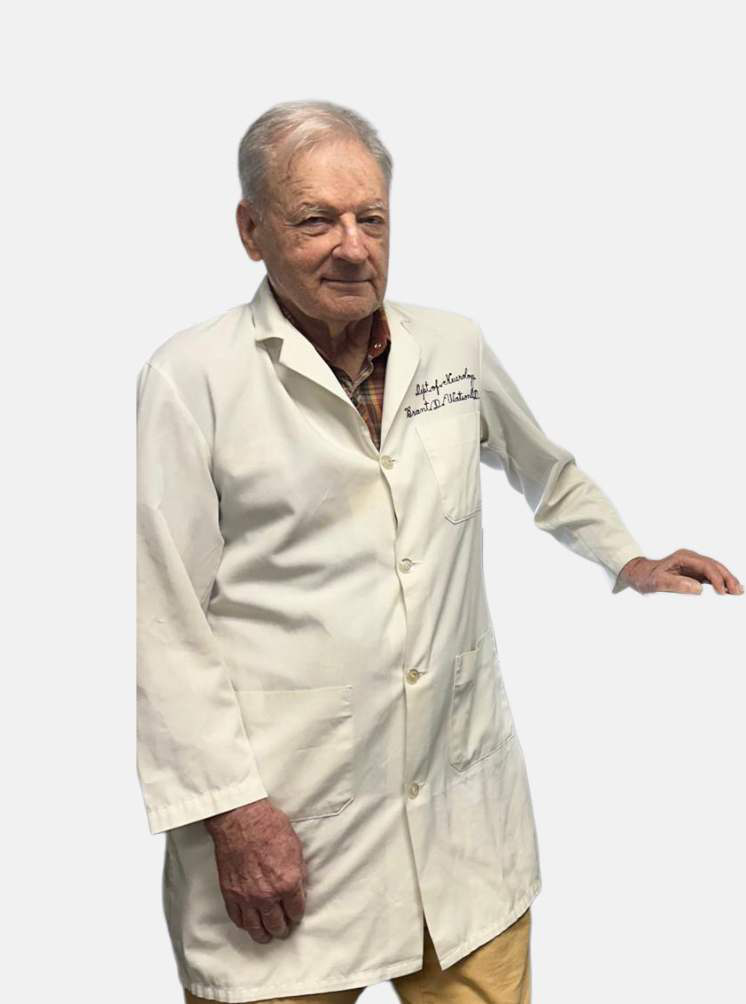
Dr. Brant Watson, PhD
Leading stroke researcher with 30+ years of experience and a PhD in nuclear physics. Published 90+ peer-reviewed papers, cited in 2,000+ studies.
Executive Team










Medical Board & Clinical Advisors


Additional board seats to be filled post-round.
A fully developed system - not a concept
The core technology was created by our founder, Brant Wilson. Our team engineered it into the UV-P34 laser system, and the UV-transparent balloon catheter is co-developed with Teleflex, the #1 medical device manufacturer in America. Together they add just seconds of UV light to procedures surgeons already perform.

Semi-compliant, UV-transparent balloon catheter
- A special-order microcatheter filled with UV-transparent contrast fluid centers the optical fiber inside the artery - constant beam intensity regardless of arterial tortuosity.
- The catheter inflates to the point of contact with the arterial wall, displacing blood from the beam path.
- Arterial dilation by the UV ring beam begins, and the balloon is further inflated to ensure the seal.
Endovascular delivery of a UV laser beam
A Gaussian laser beam is transformed into a conically-shaped optical-fiber ring that irradiates the inner circumference of an artery after flushing the blood - the core mechanism behind safe, rapid recanalization.

Animal studies - UPenn
Successful non-GLP exploratory studies conducted at the University of Pennsylvania.
Human studies - Italy
Early human studies conducted in Italy, demonstrating the approach in patients.
~36-month FDA path
As a fully developed medical device - not a drug - EndoUVTech targets FDA clearance in ~36 months, versus the 8-10 years typical of pharma.
Product images and technology descriptions courtesy of EndoUVTech (endouvtech.com). Development-stage device; not yet FDA cleared.
The market is shifting - and EndoUVTech is built for where it's going
Surgical device revenue is migrating from legacy capital equipment toward AI-enabled, minimally invasive, data-integrated platforms. The buyers - hospitals, ambulatory surgery centers, and specialty clinics - are demanding better outcomes at lower total cost. EndoUVTech sits on the right side of every one of these shifts.
Today's Revenue Mix
- Capital equipment
- Surgical endoscopy equipment
- Reusable surgical instruments
- Single-use consumables & disposables
- Implants
- Accessories & ancillary products
Future Revenue Mix
- Robotic, AI-enabled & navigation platforms
- Advanced MIS & endoscopic systems
- Smart OR & integrated visualization platforms
- Advanced implants
- Data-integrated visualization & workflow systems
What buyers demand - and the outcomes they're chasing
Clients' Imperatives
- Improve surgical precision & clinical outcomes
- Reduce surgical complications & readmissions
- Improve OR efficiency & workflow optimization
- Enable minimally invasive procedures
- Improve infection prevention & sterility
- Enable the shift toward outpatient & ASC procedures
- Improve supply consistency & device availability
Clients' Outcomes
- Improved patient outcomes & quality of care
- Reduced complication rates & readmissions
- Faster patient recovery & shorter length of stay
- Higher procedure volumes & operational efficiency
- Lower total cost of care
- Improved patient satisfaction
Where EndoUVTech fits: a minimally invasive, device-agnostic UV adjunct that improves surgical precision and reperfusion, reduces long-term disability and complications, integrates into existing workflow, and supports the shift to faster, higher-volume procedures - directly serving the imperatives and outcomes buyers are paying for.
Market Dynamics
- Rising burden of chronic disease accelerating long-term demand for surgical devices
- Increasing surgical intensity & procedure frequency among an ageing population
- High capital intensity & long replacement cycles slow adoption of advanced platforms
- Shortage of skilled professionals constrains market growth
- Transition toward minimally invasive & outpatient surgery expanding demand for disposable devices
- Adjunct technologies that improve outcomes without replacing existing systems
- Product recalls & device-related safety events challenge market growth
- Regulatory & reimbursement pathways require rigorous clinical evidence
Source: MarketsandMarkets Analysis - Surgical Devices Market (2026); EndoUVTech positioning added by management.
We're not reinventing the scope - we're making every thrombectomy better
EndoUVTech is a UV thrombectomy adjunct platform. It adds onto the stent retrievers, aspiration catheters, and thrombolytics that interventionalists already use - no new capital console to buy, no field to retrain, no competing device to displace. The strategic acquirer who owns this IP gains a capability that exists nowhere else in the vascular market.
What EndoUVTech is NOT
- Not a new stent retriever or aspiration system
- Not a capital console hospitals must purchase
- Not a competing thrombolytic drug
- Not a rip-and-replace of existing workflow
What EndoUVTech IS
- A UV light + single-use fiber-optic balloon catheter that integrates with existing devices
- A per-procedure consumable - razor / razor-blade economics on every case
- A globally patented method (8 U.S. patents + worldwide) that works across any vascular bed
- A differentiated upgrade an acquirer drops into its existing franchise
The acquirer becomes one-of-one
Whoever owns EndoUVTech can offer the only UV-enabled thrombectomy adjunct in the world - a defensible, patent-protected differentiator competitors cannot replicate. It strengthens an existing neurovascular or peripheral-vascular franchise rather than competing with it - exactly the profile strategic acquirers pay premiums for.
Add-on technologies acquirers have paid up for
Strategics consistently acquire "bolt-on" technologies that add capability to existing surgical platforms - often for hundreds of millions to billions, well before full commercialization.
| Add-on technology | Acquirer | Year | Deal value | ≈ 2026 USD* |
|---|---|---|---|---|
| Auris Health - robotic endoscopy platform | Johnson & Johnson | 2019 | $3.4B + $2.35B earn-out | ~$4.4B |
| Novadaq - fluorescence imaging add-on | Stryker | 2017 | $701M | ~$945M |
| Augmenix (SpaceOAR) - adjunct tissue spacer | Boston Scientific | 2018 | up to $600M | ~$790M |
| Veran Medical - navigation add-on (bronchoscopy) | Olympus | 2020 | up to $340M | ~$435M |
| VisionSense - fluorescence imaging add-on | Medtronic | 2018 | up to $75M | ~$98M |
| EndoUVTech - UV thrombectomy adjunct ★ | Strategic acquirer | Target | $700M+ target | $700M+ |
*CPI-adjusted to approximate 2026 U.S. dollars; rounded. Deal values from public company announcements / SEC filings. Comparables are shown for context only and are not indicative of EndoUVTech's outcome.
What EndoUVTech must accomplish to reach a strategic exit
Each milestone de-risks the technology and steps the valuation up. This round funds the pre-clinical data package that opens the first acquisition window; the clinical and regulatory milestones that follow are what unlock the $700M+ exit.
Complete the animal data package to regulatory-submission standard (~24 months post-funding), co-developed with FDA-specialized manufacturer Teleflex. Unlocks Exit Option 1 - pre-FDA acquisition.
File the U.S. FDA pathway (510(k) / De Novo) and the EU CE-Mark for the initial indication, and engage a medical-device reimbursement consulting firm.
Generate the human clinical evidence package demonstrating safety and reperfusion benefit. Unlocks Exit Option 2 - post-FDA / pre-commercial acquisition at a higher valuation.
Achieve regulatory clearance across the initial and expanded indications (targeted 2030-31).
Establish the reimbursement pathway and scale manufacturing - the final criteria a strategic acquirer needs to fully integrate the platform.
Value inflection: completing pre-clinical data opens the first exit window; adding human clinical data plus FDA / CE clearance is what supports a $700M+ strategic acquisition, benchmarked to the adjunct and neurovascular comps. Timelines and outcomes are estimates, not guarantees.
Built to be acquired by a Medtech leader
EndoUVTech is positioned for strategic acquisition. Breakthrough improvements in surgical outcomes - protected by a global patent portfolio - are exactly what top Medtech acquirers compete for to defend and expand market share. Over 2016–2026, $100B+ in neurovascular and vascular device acquisitions have closed.
Exit Option 1 - Pre-FDA
Strategic acquisition with completed pre-clinical (animal) data package, ahead of FDA clearance. Recent comparable pre-FDA stroke/vascular exit: $455M (2015).
Exit Option 2 - Post-FDA
Acquisition after FDA / CE-Mark clearance with a completed clinical data package. Target: $700M+ exit, benchmarked to comparable interventional / neurovascular transactions ($540M–$1.1B).
Recent strategic acquisitions of interventional / neurovascular device companies
| Company | Acquirer | Deal value | Area |
|---|---|---|---|
| Auris Health | Johnson & Johnson | $3.4B + up to $2.35B earn-out | Interventional robotics |
| Corindus Vascular | Siemens Healthineers | $1.1B (all-cash) | Endovascular robotics |
| Phenox GmbH | Wallaby Medical | ~$540M (incl. milestones) | Neurovascular thrombectomy |
| Affera, Inc. | Medtronic | $925M ($675M + $250M) | Cardiac ablation |
| CardioMEMS | St. Jude Medical (Abbott) | $450M+ | Implantable cardiovascular |
| Twelve, Inc. | Medtronic | up to $458M | Transcatheter mitral valve |
| CardiAQ Valve | Edwards Lifesciences | up to $400M | Transcatheter mitral valve |
| EndoUVTech ★ target | Strategic Medtech acquirer | $700M+ target | UV thrombectomy adjunct platform |
Phenox - a neurovascular thrombectomy device maker (stent retrievers, flow diverters) - is the closest comparable to EndoUVTech's lead indication. EndoUVTech's $700M+ figure is a target acquisition value benchmarked against these comparables, not a completed transaction or a guarantee. Source: EndoUVTech data room, "Recent Thrombectomy / Neurovascular Exits."
Recent crowdfunded medtech raises (reference comps)
| Company | Valuation | Raised | Notes |
|---|---|---|---|
| Pirouette Pharma | $95M | $5M | Marketing spend undisclosed |
| Breath Diagnostics | $32M | $3M | $500k+ marketing campaign |
| Carnyx Therapeutics | $45M | - | ~$1M marketing campaign |
| EndoUVTech (this round) | $30M cap | $5M goal | SPV + SAFE · 20% discount to next round |
Comparable transactions are shown for context only. Past valuations and exits of other companies are not indicative of EndoUVTech's future results.
The path to clearance and exit
Proof of concept completed in university studies · proprietary UV system developed · 8 patents issued.
Complete pre-clinical data with further animal studies - funded by this round. Pre-FDA exit option opens.
FDA & EU submissions for multiple indications. Post-FDA exit option opens.
Targeted FDA & CE-Mark clearance across indications.
One simple SPV - built for a clean sale
When you invest, your money joins a single Special Purpose Vehicle (SPV) that holds a SAFE in EndoUVTech. It's the simplest way to own a piece of the company - and it's designed to make an acquisition easy.
Why the SPV is good for you
- Invest as little as $500-$2,000 and share in the upside (Reg CF).
- Your money buys into a SAFE with a 20% discount to the next round - you get in before the next raise.
- Professionally managed. One simple line on the cap table - no paperwork headaches for you.
Why one shareholder wins at exit
A medical-device company is built to be acquired. When a buyer comes to the table, they want a clean cap table. With an SPV, the buyer deals with one shareholder - not thousands of individual investors.
1,000s of shareholders to chase, sign, and pay - slow, messy, and it can put a deal at risk.
1 shareholder, 1 signature - fast, clean, and acquisition-ready.
The SPV and SAFE structure, discount, and cap are set in the official offering documents. This is a summary for convenience, not legal or investment advice - please read the offering materials before investing.
Round 1: get in early, on the best terms
First-round investors buy into a SAFE through a single SPV, with a 20% discount to the next financing round (subject to a $30M post-money valuation cap). You're backing the company before the pre-clinical data milestone that opens the first exit window.
A SAFE held through an SPV - one clean shareholder on the cap table.
A 20% discount to the next round (subject to a $30M post-money valuation cap).
$500 minimum under Reg CF (open to everyone). $10,000 minimum for accredited investors via Reg D.
The offer: a SAFE held through an SPV, with a 20% discount to the next financing round (subject to a $30M post-money valuation cap). Minimum $500 under Reg CF; $10,000 for accredited investors under Reg D. Structure: Reg CF (open to all) running in parallel with a Reg D 506(c) offering for accredited investors writing larger checks. Final SPV, SAFE, discount, and cap terms are set in the official offering documents - please review them before investing.
Note: The valuation cap is used to determine the conversion price upon a qualifying equity financing and does not necessarily represent the current fair market value of the company.
Where your investment goes
This round funds the pre-clinical (animal) data package - expected to complete ~24 months post-funding - which initiates the first strategic-acquisition exit option ahead of FDA clearance.
Allocation is an estimate and may be adjusted by management as the program advances. See the official offering documents for the binding use-of-funds statement.
Why Chip Van Vurst built EndoUVTech
Chip Van Vurst is a repeat medical-technology founder. As CEO and founder of Biostem Technologies, he built the company from inception toward a NASDAQ up-listing and hundreds of millions in annual revenue. With EndoUVTech he has turned that operating and public-market experience toward a single mission: medical solutions that reduce suffering and improve lives worldwide.
[ Founder's personal story - add the life experience that drives Chip's focus on patient outcomes here. ]
His focus has stayed constant: take breakthrough science out of the lab and into the operating room, where it can give stroke patients - and their families - their lives back. That conviction is the reason EndoUVTech exists.
Revolutionary - and built to be adopted, not resisted
Integrates, doesn't compete
Works alongside stent retrievers, aspiration devices, and tPA. Surgeons add it to the workflow they already trust.
Reaches the unreachable
Dissolves distal platelet clots that mechanical and pharmaceutical approaches physically cannot address.
Globally patented moat
8 U.S. patents granted, 3 registered worldwide, more in the pipeline - protecting the method and the technology.
Validated at UPenn
Successful non-GLP exploratory animal studies at the University of Pennsylvania; devices co-developed with FDA-specialized manufacturer Teleflex.
Razor / razor-blade model
UV system plus single-use fiber-optic catheters - recurring per-procedure revenue across every case.
One platform, many organs
The same UV technology extends across the body's vascular system - a multi-indication IP engine.
Frequently asked questions
A SAFE held through a single SPV that pools all crowdfunding investors into one shareholder. It converts at the next round with a 20% discount (subject to a $30M post-money valuation cap). The minimum is $500 under Regulation CF (open to everyone) or $10,000 for accredited investors under Regulation D. Full terms are in the official offering documents.
$500 under Regulation CF (open to everyone, investments under $10,000). Accredited investors contributing $10,000 or more invest via the parallel Regulation D offering.
The strategy is a strategic acquisition by a Medtech leader. Two windows: a pre-FDA acquisition after the pre-clinical data package (funded by this round), and a post-FDA/CE-Mark acquisition later. Comparable neurovascular exits have closed around $450M, within $100B+ of sector M&A since 2016.
8 U.S. patents granted, 3 registered worldwide, with more in the pipeline - covering the method and the technology of integrating UV light through a fiber-optic cable with existing stroke devices, across any anatomical structure.
Completed proof of concept in university studies, successful non-GLP exploratory animal studies at the University of Pennsylvania, devices co-developed with FDA-specialized manufacturer Teleflex, and a granted global patent portfolio.
This is an early, pre-clinical medical-device company. Investment in startups is high-risk and illiquid; you could lose your entire investment. The company has not received FDA clearance, regulatory and clinical outcomes are uncertain, and an acquisition is a goal, not a guarantee. Please read the full risk factors in the official offering documents.
Back the new standard in stroke surgery
Two ways to invest in the same round - a SAFE via SPV with a 20% discount to the next round. Choose your path:
Prefer to talk first? Contact the team or view the investment deck.
Data sources
Market, financial, and comparable-transaction figures cited on this page are drawn from the sources below - all published 2024 or later. Forward-looking estimates and target figures are illustrative and not guarantees.
- MarketsandMarkets - Surgical Devices Market, Global Forecast to 2031 (2026). Global surgical devices market $188.7B (2026) → $296.8B (2031), 9.5% CAGR.
- World Stroke Organization - Global Stroke Fact Sheet 2025 (Feigin et al., 2025; based on Global Burden of Disease 2021, The Lancet Neurology, Sept 2024). ~1 in 4 lifetime stroke risk; 12M+ first strokes/year; global cost > US$890B.
- Penumbra, Inc. - Q4 & Full Year 2024 Financial Results (Feb 2025). Thrombectomy revenue and U.S. growth validating sector momentum.
- Stryker - Acquisition of Inari Medical ($4.9B) (2025). VTE / peripheral-vascular market context (~$6B U.S. VTE opportunity).
- EndoUVTech Investor Data Room - Thrombectomy Market TAM/SAM/SOM Analysis (2025–2030) (2025). $3.16B TAM; regional & indication breakdown; SAM/SOM.
- EndoUVTech Investor Data Room - Recent Thrombectomy / Neurovascular Exits (2025). Comparable strategic acquisitions underpinning the $700M+ exit target.
- American Heart Association - Heart Disease & Stroke Statistics, 2025 Update. Average age of first stroke; annual U.S. stroke incidence; recovery and cost data.
- U.S. Centers for Disease Control - Stroke Facts (2024). 795,000 strokes/year; one every 40 seconds; rising incidence among adults 18-44.
CF · or $10k+ accredited